Swimming pools designed for professional training and competitions need to follow specific measurements to provide a consistent swimming environment. Among the most recognized pool formats is the Olympic-size pool, which is designed for high-level competitive swimming. Understanding the correct swimming pool dimensions, depth, lane arrangement, and other requirements is important when planning a professional or training facility.
UNS Global provides swimming pool solutions for residential, commercial, institutional, hospitality, and sports applications. Our company understands that pool design should be based on the intended use, available space, circulation requirements, and user needs. Whether a project requires a competition-style pool or a customized recreational pool, UNS Global can offer solutions according to the project requirements.
What Is the Olympic Swimming Pool Size?
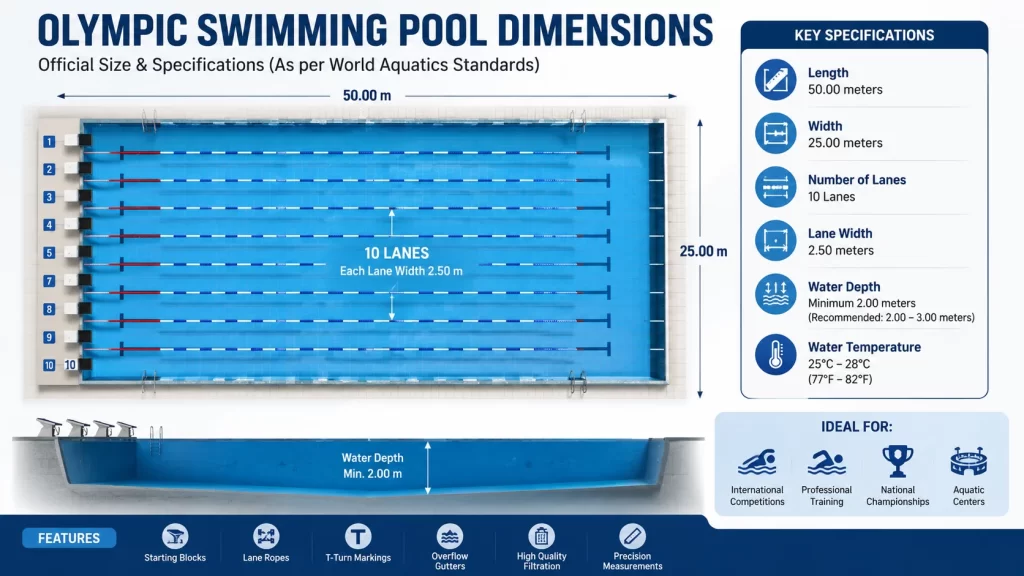
The standard olympic swimming pool size for long-course competition is 50 metres in length. World Aquatics regulations also recognize 25-metre pools for short-course competitions. For Olympic Games competition pools, the permanent pool width is required to be at least 25 metres.
A typical Olympic competition pool is therefore commonly described as 50 metres × 25 metres. However, the complete facility involves more than simply constructing a pool of these dimensions. Lane widths, starting platforms, touch panels, markings, water movement, depth, and other technical details also need to be considered.
Olympic Swimming Pool Length
One of the most recognized standards is the Olympic swimming pool length. The official length of an Olympic swimming pool is:
- 10 swimming lanes
- 50 meters long
- 25 meters wide
The olympic size pool length of 50 meters allows swimmers to compete in internationally recognized long-course events. Precision is critical, and even small variations can affect race outcomes.
Official Width and Lane Requirements
Besides the Olympic swimming pool length, the pool width is equally important.
Standard Olympic pool width includes:
- Total width: 25 meters
- Ten lanes
- Each lane width: 2.5 meters
- Additional space outside the outer lanes
The extra lanes help reduce wave interference during competitions, creating fairer racing conditions for athletes.
Proper lane allocation is one of the key swimming pool specs required for professional-level swimming facilities.
Olympic Pool Depth Standards
Pool depth directly affects swimmer performance and safety. Modern Olympic pools generally have a minimum depth of:
- 2 meters (6.5 feet)
- Preferred depth: 3 meters or more
Deeper water reduces turbulence caused by swimmers, allowing for faster race times and improved performance.
Many world-class aquatic centers now exceed minimum depth requirements to create optimal racing conditions for international competitions.
Half Olympic Size Swimming Pool
Not every facility requires a full Olympic pool. A half Olympic size swimming pool is a popular alternative for training centers, schools, and clubs. These pools typically measure 25 meters in length and maintain proportional width and depth.
The half Olympic size swimming pool is ideal for practice sessions and local competitions. It offers the benefits of a professional setup while reducing space and construction costs. UNS Global continues to offer customized solutions for such pools, ensuring high quality and durability.
Difference Between Olympic Pool vs Semi-Olympic Pool
| Feature | Olympic Pool | Semi-Olympic Pool |
|---|---|---|
| Length | 50 meters | 25 meters |
| Width | 25 meters | 12.5–25 meters |
| Number of Lanes | 10 lanes | 6–8 lanes (typically) |
| Primary Use | International competitions | Training, schools, clubs, local events |
| Construction Cost | Higher investment | More affordable and cost-effective |
Semi Olympic Swimming Pool Size
The semi Olympic size swimming pool usually has a length of 25 meters and is widely used in fitness centers, hotels, and residential complexes. The advantage of a semi Olympic swimming pool size is that it balances performance and practicality. It provides enough space for serious swimmers while being more cost-effective than a full Olympic pool.
Swimming Pool Specs for Competition Pools
Several technical factors contribute to official swimming pool specs beyond length and depth.
Important specifications include:
- Starting Platforms: Competition pools require elevated starting blocks positioned at each lane.
- Timing Systems: Electronic timing equipment ensures precise race measurement.
- Lane Ropes: Specially designed lane dividers minimize wave disruption and improve swimmer performance.
- Water Circulation: Efficient filtration and circulation systems maintain water quality and visibility.
- Overflow Gutters: Perimeter overflow systems help control water movement and reduce wave reflection.
These elements collectively contribute to a professional competition environment.
Why Pool Dimensions Matter
Pool dimensions influence much more than appearance. Accurate sizing affects:
- Competition Accuracy: Official distances ensure fair and standardized racing conditions.
- Athlete Performance: Correct dimensions help swimmers train under realistic competition conditions.
- Safety Standards: Appropriate depth and lane spacing reduce accident risks.
- Facility Value: Pools meeting international standards often attract professional events and training programs.
- Long-Term Compliance: Following approved swimming pool specs helps avoid costly modifications later.
Whether constructing a full Olympic facility or a semi olympic swimming pool size, proper planning is essential.
Understanding Olympic size pool dimensions, including the correct Olympic size pool length, is essential for building a high-performance swimming facility. While full Olympic pools are ideal for competitions, options like half Olympic size swimming pool and semi Olympic size swimming pool offer flexibility for different needs.
UNS Global continues to provide expert solutions that combine quality, precision, and innovation. Whether you need a professional Olympic pool or a customized semi Olympic swimming pool size, we ensure that your project meets the highest standards of excellence.